
برتر فایل
یک سایت مرجع با هدف انتشار آموزشهای کاربردی از نرم افزارهای مهندسی (CAD CAE CAP CAM)، تحقیق، پروژه، جزوه، کتاب و... است که به منظور دسترسی راحتتر، سریعتر و ارزانتر شما دانشجویان و پژوهشگران به تحقیقات مد نظرتان تاسیس شده است.
برتر فایل
یک سایت مرجع با هدف انتشار آموزشهای کاربردی از نرم افزارهای مهندسی (CAD CAE CAP CAM)، تحقیق، پروژه، جزوه، کتاب و... است که به منظور دسترسی راحتتر، سریعتر و ارزانتر شما دانشجویان و پژوهشگران به تحقیقات مد نظرتان تاسیس شده است.مقدمه ای بر مکانیک محیط های پیوسته
پروفسور جی ان ردی یک استاد برجسته در دانشکده مهندسی مکانیک دانشگاه تگزاس می باشد. این استاد برجسته در سطح بین المللی به خاطر تبحر در علوم مکانیک محاسباتی و مکانیک کاربردی و همچنین تالیف 17 کتاب و ارائه بیش از 450 مقاله در ژورنال های مختلف علمی شناخته شده می باشد. کتاب مقدمه ای بر مکانیک محیط های پیوسته پروفسور ردی فرم غیرمادی و جزء را معرفی می نماید. در این کتاب فرم معادلات اساسی و برنامه های کاربردی آنها به مشکلات در کشش، مکانیک سیالات، و انتقال حرارت و معرفی مختصر به ویسکوالاستیک خطی را نیز ارائه می دهد. این کتاب برای دانشجویان تحصیلات تکمیلی بسیار ایده آل می باشد. همچنین این کتاب برای کسانی که به دنبال کار بیشتر در زمینه های دینامیک سیالات، انعطاف پذیری، صفحات و پوسته ها، ویسکوزولاسیون، پلاستیک و زمینه های بین رشته ای مانند ژئومکانیک، بیومکانیک، مکانیولوژی و علوم نانو هستند می تواند مفید واقع گردد...
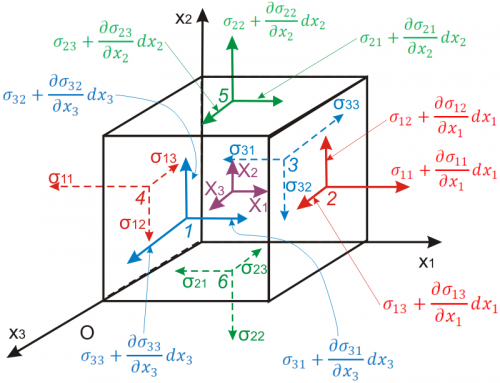
کتاب مقدمه ای بر مکانیک محیط های پیوسته (Introduction to Continuum Mechanics)، مشتمل بر 480 صفحه، در 9 فصل، با فرمت PDF، به زبان انگلیسی، همراه با مثال ها و تمرینات متعدد به ترتیب زیر گردآوری شده است:
- Continuum Mechanics
- A Look Forward
- Summary
- Problems
Chapter 2: VECTORS AND TENSORS
- Background and Overview
- Vector Algebra
- Definition of a Vector
- Vector addition
- Multiplication of a vector by a scalar
- Linear independence of vectors
- Scalar and Vector Products
- Scalar product
- Vector product
- Triple products of vectors
- Plane Area as a Vector
- Reciprocal Basis
- Components of a vector
- General basis
- Ortho normal basis
- The Gram–Schmidt ortho normalization
- Summation Convention
- Dummy index
- Free index
- Kronecker delta
- Permutation symbol
- Transformation Law for Different Bases
- General transformation laws
- Transformation laws for orthonormal systems
- Theory of Matrices
- Definition
- Matrix Addition and Multiplication of a Matrix by a Scalar
- Matrix Transpose
- Symmetric and Skew Symmetric Matrices
- Matrix Multiplication
- Inverse and Determinant of a Matrix
- Positive-Definite and Orthogonal Matrices
- Vector Calculus
- Differentiation of a Vector with Respect to a Scalar
- .Curvilinear Coordinates
- The Fundamental Metric
- Derivative of a Scalar Function of aVector
- The Del Operator
- Divergence and Curl of a Vector
- Cylindrical and Spherical Coordinate Systems
- Gradient, Divergence, and Curl Theorems
- Tensors
- Dyads and Dyadics
- Nonion Form of a Second-Order Tensor
- Transformation of Components of a Tensor
- Higher-Order Tensors
- Tensor Calculus
- Eigenvalues and Eigenvectors
- Eigenvalue problem
- Eigenvalues and eigen vectors of a real symmetric tensor
- Spectral theorem
- Calculation of eigenvalues and eigen vectors
- Summary
- Problems
Chapter 3: KINEMATICS OF CONTINUA
- Introduction
- Descriptions of Motion
- Configurations of a Continuous Medium
- Material Description
- Spatial Description
- Displacement Field
- Analysis of Deformation
- Deformation Gradient
- Isochoric, Homogeneous, and In homogeneous Deformation
- Isochoric deformation
- Homogeneous deformation
- Nonhomogeneous deformation
- Change of Volume and Surface
- Volume change
- Area change
- Strain Measures
- Cauchy Green Deformation Tensors
- Green Lagrange Strain Tensor
- Physical Interpretation of Green–Lagrange Strain Components
- Cauchy and Euler Strain Tensors
- Transformation of Strain Components
- Invariants and Principal Values of Strains
- Infinitesimal Strain Tensor and Rotation Tensor
- Infinitesimal Strain Tensor
- Physical Interpretation of Infinitesimal Strain
- Tensor Components
- Infinitesimal Rotation Tensor
- Infinitesimal Strains in Cylindrical and Spherical
- Coordinate Systems
- Cylindrical coordinate system
- Spherical coordinate system
- Velocity Gradient and Vorticity Tensors
- Relationship Between D and ˙E
- Compatibility Equations
- Preliminary Comments
- Infinitesimal Strains
- Finite Strains
- Rigid-Body Motions and Material Objectivity
- Superposed Rigid-Body Motions
- Introduction and rigid-body transformation
- Effect on F
- Effect on C and E
- Effect on L and D
- Material Objectivity
- Observer transformation
- Objectivity of various kinematic measures
- Time rate of change in a rotating frame of reference
- Polar Decomposition Theorem
- Preliminary Comments
- Rotation and Stretch Tensors
- Objectivity of Stretch Tensors
- Summary
- Problems
- Introduction
- Cauchy Stress Tensor and Cauchy’s Formula
- Stress Vector
- Cauchy’s Formula
- Cauchy Stress Tensor
- Transformation of Stress Components and Principal Stresses
- Transformation of Stress Components
- Invariants
- Transformation equations
- Principal Stresses and Principal Planes
- Maximum Shear Stress
- Other Stress Measures
- Preliminary Comments
- First Piola Kirchhoff Stress Tensor
- Second Piola Kirchhoff Stress Tensor
- Equilibrium Equations for Small Deformations
- Objectivity of Stress Tensors
- Cauchy Stress Tensor
- First Piola Kirchhoff Stress Tensor
- Second Piola Kirchhoff Stress Tensor
- Summary
- Problems
Chapter 5: CONSERVATION AND BALANCE LAWS
- Introduction
- Conservation of Mass
- Preliminary Discussion
- Material Time Derivative
- Vector and Integral Identities
- Vector identities
- Integral identities
- Continuity Equation in the Spatial Description
- Continuity Equation in the Material Description
- Reynolds Transport Theorem
- Balance of Linear and Angular Momentum
- Principle of Balance of Linear Momentum
- Equations of motion in the spatial description
- Equations of motion in the material description
- Spatial Equations of Motion in Cylindrical and Spherical Coordinates
- Cylindrical coordinates
- Spherical coordinates
- Principle of Balance of Angular Momentum
- Mono polar case
- Multi polar case
- Thermodynamic Principles
- Balance of Energy
- Energy equation in the spatial description
- Energy equation in the material description
- Entropy Inequality
- Homogeneous processes
- In homogeneous processes
- Conservation and Balance Equations in the Spatial Description
- Conservation and Balance Equations in the Material Description
- Closing Comments
- Problems
Chapter 6: CONSTITUTIVE EQUATIONS
- Introduction
- General Comments
- General Principles of Constitutive Theory
- Material Frame Indifference
- Restrictions Placed by the Entropy Inequality
- Elastic Materials
- Cauchy Elastic Materials
- Green-Elastic or Hyper elastic Materials
- Linearized Hyper elastic Materials: Infinitesimal Strains
- Hookean Solids
- Generalized Hooke’s Law
- Material Symmetry Planes
- Monoclinic Materials
- Orthotropic Materials
- Isotropic Materials
- Nonlinear Elastic Constitutive Relations
- Newtonian Fluids
- Ideal Fluids
- Viscous In compressible Fluids
- Generalized Newtonian Fluids
- Inelastic Fluids
- Power law model
- Carreau model
- Bingham model
- Visco elastic Constitutive Models
- Differential models
- Integral models
- Heat Transfer
- Fourier’s Heat Conduction Law
- Newton’s Law of Cooling
- Stefan–Boltzmann Law
- Constitutive Relations for Coupled Problems
- Electro magnetics
- Maxwell’s equations
- Constitutive relations
- Thermo elasticity
- Hygro thermal elasticity
- Electro elasticity
- Summary
- Problems
Chapter 7: LINEARIZED ELASTICITY
- Introduction
- Governing Equations
- Preliminary Comments
- Summary of Equations
- Strain displacement equations
- Equations of motion
- Constitutive equations
- Boundary conditions
- Compatibility conditions
- The Navier Equations
- The Beltrami Michell Equations
- Solution Methods
- Types of Problems
- Types of Solution Methods
- Examples of the Semi Inverse Method
- Stretching and Bending of Beams
- Superposition Principle
- Uniqueness of Solutions
- Clapeyron’s, Betti’s, and Maxwell’s Theorems
- Clapeyron’s Theorem
- Betti’s Reciprocity Theorem
- Maxwell’s Reciprocity Theorem
- Solution of Two-Dimensional Problems
- Plane Strain Problems
- Plane Stress Problems
- Unification of Plane Stress and Plane Strain Problems
- Airy Stress Function
- Saint Venant’s Principle
- Torsion of Cylindrical Members
- Warping function
- Prandtl’s stress function
- Methods Based on Total Potential Energy
- The Variational Operator
- The Principle of the Minimum Total Potential Energy
- Construction of the total potential energy functional
- Euler’s equations and natural boundary conditions
- Minimum property of the total potential energy functional
- Castigliano’s TheoremI
- The Ritz Method
- The variational problem
- Description of the method
- Hamilton’s Principle
- Hamilton’s Principle for a Rigid Body
- Hamilton’s Principle for a Continuum
- Summary
- Problems
Chapter 8: FLUID MECHANICS AND HEAT TRANSFER
- Governing Equations
- Preliminary Comments
- Summary of Equations
- Fluid Mechanics Problems
- Governing Equations of Viscous Fluids
- In viscid Fluid Statics
- Parallel Flow (Navier Stokes Equations)
- Problems with Negligible Convective Terms
- Energy Equation for One-Dimensional Flows
- Heat Transfer Problems
- Governing Equations
- Heat Conduction in a Cooling Fin
- Axisymmetric Heat Conduction in a Circular Cylinder
- Two Dimensional Heat Transfer
- Coupled Fluid Flow and Heat Transfer
- Summary
- Problems
Chapter 9: LINEARIZED VISCOELASTICITY
- Introduction
- Preliminary Comments
- Initial Value Problem, the Unit Impulse, and the Unit Step Function
- The Laplace Transform Method
- Spring and Dashpot Models
- Creep Compliance and Relaxation Modulus
- Maxwell Element
- Creep response
- Relaxation response
- Kelvin Voigt Element
- Creep response
- Relaxation response
- Three Element Models
- Four Element Models
- Integral Constitutive Equations
- Hereditary Integrals
- Hereditary Integrals for Deviatoric Components
- The Correspondence Principle
- Elastic and Viscoelastic Analogies
- Summary
- Problems

جهت دانلود کتاب مقدمه ای بر مکانیک محیط های پیوسته (Introduction to Continuum Mechanics)، برلینک زیر کلیک نمایید.
مقدمه ای بر مکانیک محیط های پیوسته
تانسورها ، ریاضیات نظریه نسبیت و مکانیک پیوسته
کتاب تانسورها - ریاضیات نظریه نسبیت و مکانیک پیوسته (Tensors - The Mathematics of Relativity Theory and Continuum Mechanics)، مشتمل بر 300 صفحه، در 7 فصل، با فرمت PDF، به زبان انگلیسی، همراه با مثال ها و تمرینات متعدد به ترتیب زیر گردآوری شده است:
Chapter 1: Finite Dimensional Vector Spaces and Linear Mappings
- Fields
- Finite-Dimensional Vector Spaces
- Linear Mappings of a Vector Space
- Dual or Covariant Vector Spaces
- Second-Order Tensors
- Higher Order Tensors
- Exterior or Grassmann Algebra
- Inner Product Vector Spaces and the
- Metric Tensor
Chapter 3: Tensor Analysis on a Differentiable Manifold
- Differentiable Manifolds
- Tangent Vectors, Cotangent Vectors, and Parametrized Curves
- Tensor Fields over Differentiable Manifolds
- Differential Forms and Exterior Derivatives
Chapter 4: Differentiable Manifolds with Connections
- The Affine Connection and Covariant Derivative
- Covariant Derivatives of Tensors along a Curve
- Lie Bracket, Torsion, and Curvature Tensor
Chapter 5: Riemannian and Pseudo-Riemannian Manifolds
- Metric Tensor, Christoffel Symbols and Ricci Rotation Coefficients
- Covariant Derivatives and the Curvature Tensor
- Curves, Frenet Serret Formulas and Geodesics
- Special Coordinate Charts
Chapter 6: Special Riemannian and Pseudo-Riemannian Manifolds
- Flat Manifolds
- The Space of Constant Curvature
- Einstein Spaces
- Conformally Flat Spaces
Chapter 7: Hypersurfaces, Submanifolds, and Extrinsic Curvature
- Two-Dimensional Surfaces Embedded in a Three Dimensional Space
- (N −1)-Dimensional Hypersurface
- D-Dimensional Submanifolds
جهت دانلود کتاب تانسورها - ریاضیات نظریه نسبیت و مکانیک پیوسته (Tensors - The Mathematics of Relativity Theory and Continuum Mechanics)، برلینک زیر کلیک نمایید.
تانسورها ، ریاضیات نظریه نسبیت و مکانیک پیوسته
مجموعه کدهای تخمین حالت و پارامتر با فیلتر کالمن
تهیه اطلاعات پیوسته به روز و دقیق در مورد مکان و سرعت یک شی معین فقط به کمک توالی مشاهدات در مورد موقعیت آن شی، که هر کدام شامل مقداری خطاست امکان پذیر است. این فیلتر در طیف گستردهای از کاربریهای مهندسی از رادار گرفته تا بصیرت رایانهای کاربرد دارد. روش تصفیه کالمن یکی از عناوین مهم در تئوری کنترل و مهندسی سیستمهای کنترلی میباشد.
فیلتر کالمن (Kalman Filter) یک فیلتر بازگشتی کارامد است که حالت یک سیستم پویا را از یک سری اندازه گیریهای همراه با خطا بر آورد میکند. به همراه یک تنظیم کننده خطی مرتبه دوم (linear quadratic regulator LQR) فیلتر کالمن مسائل Gaussian control خطی مرتبه دوم (linear-quadratic Gaussian control - LQG) را حل میکند. فیلتر کالمن، LQR و LQG راه حلی هستند برای آنچه شاید اساسیترین مسائل تئوری کنترل می نامند...
کتاب نظریه و تمرین فیلتر کالمن با استفاده از نرم افزار متلب (Kalman Filtering - Theory and Practice Using MATLAB)، مشتمل بر 9 فصل، 582 صفحه، با فرمت pdf، همراه با تصاویر، به زبان انگلیسی، به ترتیب زیر گردآوری شده است:
Chapter 1: General Information
- On Kalman Filtering
- On Optimal Estimation Methods
- On the Notation Used In This Book
- Summary
- Problems
Chapter 2: Linear Dynamic Systems
- Chapter Focus
- Dynamic System Models
- Continuous Linear Systems and Their Solutions
- Discrete Linear Systems and Their Solutions
- Observability of Linear Dynamic System Models
- Summary
- Problems
Chapter 3: Random Processes and Stochastic Systems
- Chapter Focus
- Probability and Random Variables (RVs)
- Statistical Properties of RVs
- Statistical Properties of Random Processes (RPs)
- Linear RP Models
- Shaping Filters and State Augmentation
- Mean and Covariance Propagation
- Relationships Between Model Parameters
- Orthogonality Principle
- Summary
- Problems
Chapter 4: Linear Optimal Filters and Predictors
- Chapter Focus
- Kalman Filter
- Kalman–Bucy Filter
- Optimal Linear Predictors
- Correlated Noise Sources
- Relationships Between Kalman–Bucy and Wiener Filters
- Quadratic Loss Functions
- Matrix Riccati Differential Equation
- Matrix Riccati Equation In Discrete Time
- Model Equations for Transformed State Variables
- Application of Kalman Filters
- Summary
- Problems
- Chapter Focus
- Fixed-Interval Smoothing
- Fixed-Lag Smoothing
- Fixed-Point Smoothing
- Summary
- Problems
Chapter 6: Implementation Methods
- Chapter Focus
- Computer Round off
- Effects of Round off Errors on Kalman Filters
- Factorization Methods for Square-Root Filtering
- Square-Root and UD Filters
- Other Implementation Methods
- Summary
- Problems
Chapter 7: Nonlinear Filtering
- Chapter Focus
- Quasilinear Filtering
- Sampling Methods for Nonlinear Filtering
- Summary
- Problems
Chapter 8: Practical Considerations
- Chapter Focus
- Detecting and Correcting Anomalous Behavior
- Prefiltering and Data Rejection Methods
- Stability of Kalman Filters
- Suboptimal and Reduced-Order Filters
- Schmidt–Kalman Filtering
- Memory, Throughput, and Wordlength Requirements
- Ways to Reduce Computational Requirements
- Error Budgets and Sensitivity Analysis
- Optimizing Measurement Selection Policies
- Innovations Analysis
- Summary
- Problems
Chapter 9: Applications to Navigation
- Chapter Focus
- Host Vehicle Dynamics
- Inertial Navigation Systems (INS)
- Global Navigation Satellite Systems (GNSS)
- Kalman Filters for GNSS
- Loosely Coupled GNSS/INS Integration
- Tightly Coupled GNSS/INS Integration
- Summary
- Problems
* توجه:
لازم به ذکر است که علاوه بر فایل کتاب آموزشی بالا، مجموعه کدهای تخمین حالت و پارامتر با فیلتر کالمن در نرم افزار MATLAB، جهت آموزش هرچه بهتر این مبحث نیز جهت دانلود قرار داده شده است:
- مدل سیمیولینک و برنامه فیلتر کالمن استاندار یک بعدی 1D standard Kalman Filter (Simulink model and program)
- بسته جامع فیلتر کالمن (Kalman Filter Package)
- فایل آموزشی فیلتر کالمن در متلب Kalman Filter in Matlab (Tutorial)
- آموزش فیلتر کالمن بی رد (Learning the Unscented Kalman Filter)
- فیلتر کالمن خطی (Linear Kalman Filter)
- چارچوب فیلتر کالمن برای تخمین حالت و پارامتر در متلب (Kalman filtering framework)
- فیلتر کالمن برای رفع نویز فیلم های دارای نویز (Kalman filter for noisy movies)
- بهینه سازی کمترین مربعات غیر خطی با استفاده از تخمین پارامتر توسط فیلتر کالمن بی رد (Nonlinear least square optimization through parameter estimation using the Unscented Kalman Filter)
- یادگیری فیلتر کالمن از دیدگاه فیدبک (Learning the Kalman Filter: A Feedback Perspective)
- آموزش پیاده سازی فیلتر کالمن در سیمیولینک (Learning Kalman Filter Implementation in Simulink)
- آموزش فیلتر کالمن توسعه یافته (Learning the Extended Kalman Filter)
- فیلتر کالمن توسعه یافته دوگانه (Dual Extended Kalman Filter)
- فیلتر کالمن توسعه یافته برای داده های سیستم موقعیت دهی عمومی (Extended Kalman Filter(EKF) for GPS)
- آموزش و طراحی شبکه های عصبی مصنوعی با استفاده از فیلتر کالمن بی رد (Neural Network training using the Unscented Kalman Filter)
- فیلتر کالمن دسته ای (Ensemble Kalman Filter)
- رابط گرافیکی یا GUI برای رفع نویز سیگنال های ویدئویی و تصویری با استفاده از فیلتر کالمن (GUI for denoising video signals with Kalman filter)
- تعقیب هدف دو بعدی با استفاده از فیلتر کالمن (2D Target tracking using Kalman filter)
- تخمین یک حالت دارای مقدار ثابت با استفاده از فیلتر کالمن (Estimating a constant state using the Kalman Filter)
- فیلتر کالمن سلسله مراتبی برای پیش بینی سری های زمانی پزشکی (Hierarchical Kalman Filter for clinical time series prediction)
- آموزش و طراحی شبکه های عصبی مصنوعی با استفاده از فیلتر کالمن توسعه یافته (Neural Network training using the Extended Kalman Filter)

جهت دانلود کتاب آموزشی و مجموعه کدهای تخمین حالت و پارامتر با فیلتر کالمن در نرم افزار MATLAB برلینک زیر کلیک نمایید.
مجموعه کدهای تخمین حالت و پارامتر با فیلتر کالمن
حل کردن مشکلات با استفاده از نرم افزار متلب
This book is for people who need to solve ordinary differential equations (ODEs), both initial value problems (IVPs) and boundary value problems (BVPs) as well as delay differential equations (DDEs). These topics are usually taught in separate courses of length one semester each, but Solving ODEs with MATLAB provides a sound treatment of all three in about 250 pages. The chapters on each of these topics begin with a discussion of “the facts of life” for the problem, mainly by means of examples. Numerical methods for the problem are then developed
– but only the methods most widely used. Although the treatment of each method is brief and technical issues are minimized, the issues important in practice and for understanding the codes are discussed. Often solving a real problem is much more than just learning how to call a code. The last part of each chapter is a tutorial that shows how to solve problems by means of small but realistic examples
کتاب حل کردن مشکلات با استفاده از نرم افزار متلب (Solving ODEs with MATLAB)، مشتمل بر 4 فصل، 265 صفحه، با فرمت pdf، همراه با تصاویر، به زبان انگلیسی، به ترتیب زیر گردآوری شده است:
- Introduction
- Existence, Uniqueness, and Well Posedness
- Standard Form
- Control of the Error
- Qualitative Properties
Chapter 2: Initial Value Problems
- Introduction
- Numerical Methods for IVPs
- One-Step Methods
- Methods with Memory
- Solving IVPs in Matlab
- Event Location
- ODEs Involving a Mass Matrix
- Large Systems and the Method of Lines
- Singularities
Chapter 3: Boundary Value Problems
- Introduction
- Boundary Value Problems
- Boundary Conditions
- Boundary Conditions at Singular Points
- Boundary Conditions at Infinity
- Numerical Methods for BVPs
- Solving BVPs in Matlab
Chapter 4: Delay Differential Equations
- Introduction
- Delay Differential Equations
- Numerical Methods for DDEs
- Solving DDEs in Matlab
- Other Kinds of DDEs and Software
- Bibliography
- Index
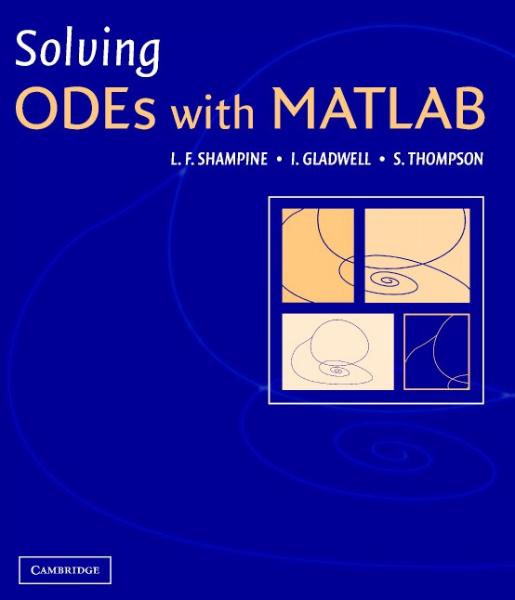
جهت دانلود کتاب حل کردن مشکلات با استفاده از نرم افزار متلب (Solving ODEs with MATLAB) برلینک زیر کلیک نمایید.
حل کردن مشکلات با استفاده از نرم افزار متلب
آموزش فشرده سازی تصاویر و ویدئو با استفاده از نرم افزار متلب
کتاب آموزش فشرده سازی تصاویر و ویدئو با استفاده از نرم افزار متلب (Still Image & Video Compression with MATLAB)، مشتمل بر 10 فصل، 443 صفحه، با فرمت pdf، همراه با تصاویر، به زبان انگلیسی، به ترتیب زیر گردآوری شده است:
- What is Source Coding
- Why is Compression Necessary
- Image and Video Compression Techniques
- Video Compression Standards
- Organization of the Book
- Summary
- References
- Introduction
- Sampling a Continuous Image
- Image Quantization
- Color Image Representation
- Summary
- References
- Problems
- Introduction
- Unitary Transforms
- Karhunen–Lo`eve Transform
- Properties of Unitary Transforms
- Summary
- References
- Problems
Chapter 4: Discrete Wavelet Transform
- Introduction
- Continuous Wavelet Transform
- Wavelet Series
- Discrete Wavelet Transform
- Efficient Implementation of 1D DWT
- Scaling and Wavelet Filters
- Two-Dimensional DWT
- Energy Compaction Property
- Integer or Reversible Wavelet
- Summary
- References
- Problems
- Introduction
- Information Theory
- Huffman Coding
- Arithmetic Coding
- Golomb–Rice Coding
- Run–Length Coding
- Summary
- References
- Problems
- Introduction
- Design of a DPCM
- Adaptive DPCM
- Summary
- References
- Problems
Chapter 7: Image Compression in the Transform Domain
- Introduction
- Basic Idea Behind Transform Coding
- Coding Gain of a Transform Coder
- JPEG Compression
- Compression of Color Images
- Blocking Artifact
- Variable Block Size DCT Coding
- Summary
- References
- Problems
Chapter 8: Image Compression in the Wavelet Domain
- Introduction
- Design of a DWT Coder
- Zero-Tree Coding
- JPEG2000
- Digital Cinema
- Summary
- References
- Problems
Chapter 9: Basics of Video Compression
- Introduction
- Video Coding
- Stereo Image Compression
- Summary
- References
- Problems
Chapter 10: Video Compression Standards
- Introduction
- MPEG-1 and MPEG-2 Standards
- MPEG-4
- H.264
- Summary
- References
- Problems
- Index
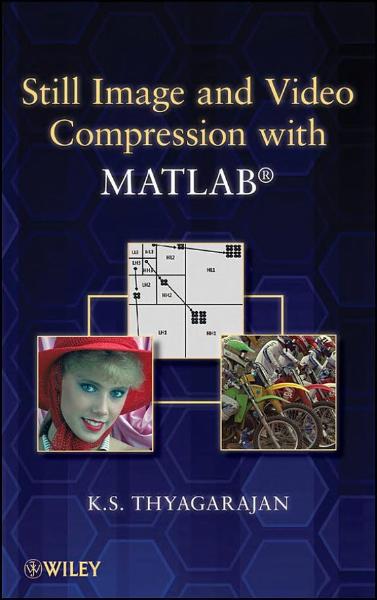
جهت دانلود کتاب آموزش فشرده سازی تصاویر و ویدئو با استفاده از نرم افزار متلب (Still Image & Video Compression with MATLAB)، برلینک زیر کلیک نمایید.